Diseno Closets

Mudrooms in Minnesota

May 26th, 2008 by Delia
Respond

Mudrooms are a MUST, in Minnesota… and everywhere where the weather is so cold that mittens, hats, boots, ear muffs, under pants, hand warmers and feet warmers are necessary for survival. Anywhere else, mudrooms are a good choice to keep your home clean of clutter at the entrance, and avoid accidents by tripping on shoes and handbags lying on the floor.  But, in Minnesota, they are a must.   The bigger, the better. 

Unbelievable as it may be, though, this is kind of a NEW concept in residential design and construction.  Old homes, even homes built as recently as in the 1950’s, did not use to have “mudrooms”.  Most of them did not even offer a “Coats Closet”!!  If you were lucky, you got some hooks on the wall.   

Where I grew up, we entered the house through the kitchen, and there was a granite top above some base cabinets…oh, my poor mother!  She always complained because we would all leave our coats and handbags, and books, and who knows what else…on that poor counter top.  Her kitchen could never stay clean and neat…but we did not have anywhere else to put our stuff!   Studying Architecture in the 70’s-80’s, I never heard the concept of “Mudrooms”, and even here, in the United States of America, I have mentioned my mudroom to people from other states, warmer states for sure, and the reaction has sometimes been: a WHAT???   When I explain the concept to them, invariably the answer is: Cool!  I wonder why I never thought about it!  I really could use one!

Yes, everybody could really use one….and that is why a lot of people these days are “remodeling” their older homes and adding these coveted mudrooms. 

I have designed cabinetry for mudrooms bigger than most people’s living rooms.  But even if more modest, any mudroom will be better than no mudroom at all.   The key to a clean, uncluttered home.

Tags: No Comments.

Closet Doors: Sliding, bifolds, mirrored and more

May 23rd, 2008 by Delia
Respond

An important decision that needs to be made in any project that includes closet sapces has to do with the type of doors you will choose for these areas.  Will the door open in?  Or out?  Why would you want it one way or another?  Should it be a slider or a pocket door ? What are the advantages and disadvantages of one against the other?  

 It is  important that we think about this seemingly trivial issue at the beginning of our design process rather than  at the end, and that we avoid leaving it to be decided by chance or luck.  Moreover, the decision might have to be done in conjunction with those decisions having to do with the design of the very interior of the closet.  Once you know how the space is best organized inside the closet, you wll be able to understand better how the different door options will impact the functioning  of that design.  A good closet designer will be able to guide you through all these phases of the design process so that when you are done, you will feel certain that your choices are the best possible.

Some door options you might be interested in considering include Japanese Shoji Screens.    Go to  Fusuma, Japanese Sliding  Doors at www.thejapaneseconnection.com/Glossary/fusuma_doors.htm or to Custom Japanese Shoji Screens - Shoji Designs Inc.  at  www.shojidesigns.com  and check out how beautiful these can be.

Another good source for door possibilities can be found at ArchiExpo.comArchiExpo is a permanent virtual exhibition, connecting manufacturers and buyers in 5 languages, around the world.  Its wealth of information, ease of use and unique services make it an essential tool for both professionals and enthusiasts.

I have found this site to be lots of fun and FULL of interesting ideas and cool products.  When you log in, look for sliding wardrobe doors, or just sliding doors and you will be taken to  pages and pages of wonderfull possibilities. 

Sliding doors can be a problem in closets, because when one leaf opens, the other stays put, and you can only see half the space, losing access to the other.  Well, in ArchiExpo I found 3 providers of what they call “Counter Frame Sliding Doors”: Protek, Ermetika, and Eclisse.  These doors seem to be sliding, but both leaves slide toward the same side and leave the opening unobstructed, solving that problem.

For your Walk In closet, you might want to keep in mind that many door manufacturers provide doors that include full length mirrors on one or both sides of the door itself, making it unnecessary for you to have to “hang” a mirror from a beautiful door,  ruinning the door in the process!

Other manufacturers I thought worth checking out in this site are Porro, Carre and Lugi.  Great looking door solutions by all three!


Tags: No Comments.

Luxury Home Tour 2008

May 15th, 2008 by Delia
Respond

The Luxury Home Tour for 2008 is soon starting once again.  Every June, for 3 consecutive weekends, the Midwest Home+Garden Magazine organizes this tour of Luxury Homes built in the Minneapolis/Saint Paul Area.  Multi-million dollar homes are open to the public to visit for a fee. 

Last year, Diseño Closets was proud to have provided all the Closet and Garage systems installed in the homes built by Le Gran Homes, in Wild Meadows, and Keith Waters in Wayzata.  The Closet Systems at the homes presented by Le Gran in Lake Elmo, Charles Cudd in Minneapolis, Greg Narr in Wayzata and JMS in Eden Prairie  also had been designed in their entirety by Delia Bornsztein, owner and president of Diseño Closets. 

This year  we are proud to be the designers and providers of the systems installed in the homes presented by 2 great builders in the tour:  Greg Narr and Ridge Creek Custom Homes.

Greg’s house is built in a very secluded area in Edina, on Merilane Rd. off of Interlachen Blvd. and Rob’s house is built in the Grays Bay Area, in Wayzata.  Both are promising to be the greatest!  I love everything these two builders build.  They both have great taste and they offer great quality in all the materials they choose.   They won’t cut corners to save money where it should not be saved and I have only heard great compliments and satisfaction from every one of their customers over the many years we have worked together.

I do hope you can all go see their (and my) work in the next few weeks.  Please note the Garage Cabinetry at Greg’s house was also installed by Diseño Closets.  Have fun!

Tags: No Comments.

Form or Function, which comes first?

May 15th, 2008 by Delia
Respond

Closets, closets, closets…. some are little, some are huge. Some are narrow, some are wide and square.  Low ceilings, high ceilings…doors and windows here, there… 

I want my closet system to look this way and that way.  I want to open the door and see this beautiful built in just across of it… I don’t really want to see my shoe racks there?  Oh no! Hanging should be hidden, and on that other wall really! I don’t want to come in and see that!…

Well, those are very valid points, neither would I want any of that!  Granted, a fabulous looking built in, with beautifull looking drawers and even doors covering all the mess behind, offers a much better view than a section of Double Hang will… BUT how will a built in in this location FUNCTION if placed where it would look the greatest?  Are there any advantages or disadvantages for this location from the point of view of  FUNTION??? 

Sometimes it is not up to US to determine where we should place a unit.  It is more up to the space to tell us what will work best.  My experience tells me that if something works well, it will also look great because it will FEEL great.  If something looks great BUT it does not work well, soon you will be hating it no matter how gorgeous it looks!

So, next time you design a closet, or any other space for that matter!, think about these 2 concepts!  Function goes first, Form follows happily ever after!

Tags: No Comments.

Closets, Spaces that demand careful expert design.

May 15th, 2008 by Delia
Respond

How are Closets different than the rest of your house?   When building a home, engineers are called to calculate the structural needs and specifications of the building.  Architects will design the overall shape of the structure, will decide where to locate the living areas, the eating areas, the sleeping areas, with relationship to the phisical properties of the lot and the needs of the client.  Interior designers will give advice on color schemes, fabrics, furniture selections. Kitchen and Bathroom designers will be best qualified for helping customers with decisions about these areas.  How about Closets?  Should your architect be in charge of deciding how to lay them out?  Or should your Kitchen/ Bathroom specialist be the one? Your interior designer?  Your cabinet maker?  The answer is, any of them might be able to come up with good solutions, but the fact  is, they do not spend all their time designing closets, and therefore, they might not be aware of certain important design rules that make closets different from Kitchens, Bathrooms, Living Rooms and others.

A designer that specializes in Closet Design and Storage Solutions will be your best resource for the project.  Some closets are so standard, that 10 different designers will come up with the same solution for it.  No variation. Just one solution for that one space.  Other closets, those that are as big as your kitchen or bedroom, with a window on one wall, a door on another, a space heater here, and an access panel somewhere else… those closets will be more “picky” and will demand something different than your standard shaped closet would.  Is your closet square?  Is it rectangular?  Is there an angle that creates a funnel somewhere?   How many people will be in the closet at one time, sharing the space, and fighting for freedom of movement to get dressed?  All these are questions that a good designer will pay attention to. 
When closet companies advertise that they are different than the competition because they “pay attention” to the customer’s needs, I wonder: Who do they pay attention to?  Because we really have 2 customers and both have to be listened to with the same degree of attention.  Our goal is to listen to the space first, discover what “IT” wants from us, lay out a plan that respects its needs and wishes and make the fruit of this “conversation” available to the real customer so that we can start a dialog between the 2, trying to fit the needs and wishes of the one with he needs and wishes of the other.  The end product will only be good if both customers are “happy”.  And a good design will achieve just that!  


Tags: No Comments.

Not Just For Clothes

May 14th, 2008 by Delia
Respond

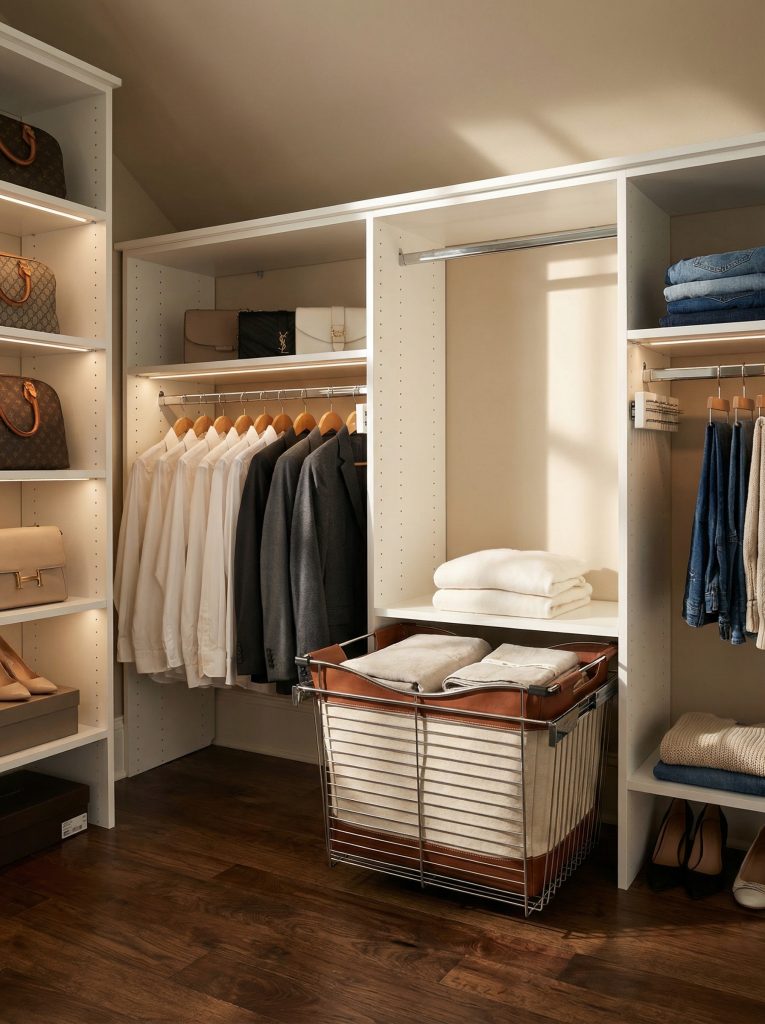
Closets are no longer just a place to hang up your clothing and store your shoes. These days we can design a closet with a built in bench to make tying your shoes more comfortable, or a pull out laundry shelf to help you when folding clothes. We can incorporate laundry machines in our closet designs so you won’t have to travel up and down the stairs to get clean clothing. The possibilities are endless. Please don’t think of your closet as just a closet any more. It’s much more than that. A place where you live day in and day out. Find out how you can make your closet the most well liked room in your house. Call us today!

Tags: No Comments.

Clothes Hangers: Which to buy?

May 14th, 2008 by Delia
Respond

A good customer of ours called us back for help with yet another closet in her house and, during our visit together, we had a chance to check out the Walk In Master Closet we had designed for her.  It looked beautiful!  And so orderly! And so clean!  There was something about it though that went beyond the system we had installed.  To be sure, it looked as beautiful as it had the day of the install, but what was it that made it so immaculate?  Believe it or not, it was THE HANGERS! They were all Black and Velvety, very very thin and yet, sturdy.  Rounded velvety edges took care of her clothes so they were happy hanging there instead of suffering from holes at the shoulders.  And, best of all, each section of Hanging was able to fit twice what I would have expected from it…just because these hangers were so slim that they took hardly any space at all!

I call them Miracle Hangers and I highly recommend them!  Wood hangers?  Yes, they are nice, BUT they take twice the space ot these hangers.  Every new closet should have new hangers. To put old wire hangers in a custom system that looks like a million dollars, (though it did not cost that much!), is a diservice to your investment. 

Where can you get these awsome hangers?  I have found these 2 sources:

www.clotheshangers.com

and, believe it or not, Ebay!   If you log onto Ebay you will be offered a wide variety of choices, amongst which you will find one that sells “huggable Hangers”. Prices are way better than the first vendor I just mentioned and you might want to give them a try.   Here is the info:


Visit my eBay Store:Forever Trading 168

Hoping this blog entry was usefull and wishing you Happy shopping!


Tags: No Comments.

The Housing Crisis: Is it over??

May 14th, 2008 by Delia
Respond


According to the Wall Street Journal, it may very well be!  We, at Diseno Closets, and all the people in the building industry world would love to know this is true… Read on and may your optimism be awakened!

This article ran in the May 6th issue of the Wall Street Journal… and according to its author, Cyril Moulle-Berteaux,  the housing crisis is NOT intensifying.  She writes that it is very likely that April 2008 will mark the bottom of the U.S. housing market.

A bottom does not mean that prices are about to return to the heady days of 2005. It just means that the trend is no longer getting worse, which is the critical factor.

Home sales peaked in July 2005.

Today, new home sales are down a staggering 63% from peak levels of 1.4 million.

Residential construction is close to 15-year lows at 3.8% of GDP; by the fourth quarter of this year, it will probably hit the lowest level ever. So what’s going to stop the housing decline? Very simply, the same thing that caused the bust: affordability.

The boom made housing unaffordable for many American families, especially first-time home buyers. During the 1990s and early 2000s, it took 19% of average monthly income to service a conforming mortgage on the average home purchased. By 2005 and 2006, it was absorbing 25% of monthly income. For first time buyers, it went from 29% of income to 37%. That just proved to be too much.

Prices got so high that people who intended to actually live in the houses they purchased (as opposed to speculators) stopped buying. This caused the bubble to burst.

Since then, house prices have fallen 10%-15%, while incomes have kept growing  and mortgage rates have come down 70 basis points from their highs. As a result, it now takes 19% of monthly income for the average home buyer, and 31% of monthly income for the first-time home buyer, to purchase a house.

In other words, homes on average are back to being as affordable as during the best of times in the 1990s. Numerous households that had been priced out of the market can now afford to get in.

Even if home sales pick up, how can home prices stop falling with so many houses vacant and unsold? Because they always do!

In the past five major housing market corrections (and there were some big ones, such as in the early 1980s when home sales also fell by 50%-60% and prices fell 12%-15% in real terms), every time home sales bottomed, the pace of house-price declines halved within one or two months.

The explanation is that by the time home sales stop declining, inventories of unsold homes have usually already started falling in absolute terms and begin to peak out in “months of supply” terms. That’s the case right now: New home inventories peaked at 598,000 homes in July 2006, and stand at 482,000 homes as of the end of March. This inventory is equivalent to 11 months of supply, a 25-year high — but it is similar to 1974, 1982 and 1991 levels, which saw a subsequent slowing in home-price declines within the next six months.

Inventories are declining because construction activity has been falling for such a long time that home completions are now just about undershooting new home sales. In a few months, completions of new homes for sale could be undershooting new home sales by 50,000-100,000 annually.

Inventories will drop even faster to 400,000 — or seven months of supply — by the end of 2008.

This shift in inventories will have a significant impact on prices, although house prices won’t stop falling entirely until inventories reach five months of supply sometime in 2009. A five-month supply has historically signaled tightness in the housing market.

Many pundits claim that house prices need to fall another 30% to bring them back in line with where they’ve been historically.  This simplistic analysis is appealing on the surface, but is flawed for a variety of reasons.

Most importantly, it neglects the fact that a great majority of Americans buy their houses with mortgages.

And if one buys a house with a mortgage, the most important factor in deciding what to pay for the house is how much of one’s income is required to be able to make the mortgage payments on the house. Today the rate on a 30-year, fixed-rate mortgage is 5.7%. Back in 1981, the rate hit 18.5%. Comparing today’s house prices to the 1970s or 1980s, when mortgage rates were stratospheric, is misguided and misleading.

This is all good news for the broader economy. The housing bust has been subtracting a full percentage point from GDP for almost two years now, which is very large for a sector that represents less than 5% of economic activity.

When the rate of house-price declines halves, there will be a wholesale shift in markets’ perceptions. All of a sudden, the expected value of the collateral (i.e. houses) for much of the lending that went on for the past decade will change. Right now, when valuing the collateral, market participants including banks are extrapolating the current pace of house price declines for another two to three years; this has a significant impact on the amount of delinquencies, foreclosures and credit losses that lenders are expected to face.

More home sales and smaller price declines means fewer homeowners will be underwater on their mortgages. They will thus have less incentive to walk away and opt for foreclosure.

A milder house-price decline scenario could lead to increases in the market value of a lot of the securitized mortgages that have been responsible for $300 billion of write-downs in the past year.

Even if write-backs do not occur, stabilizing collateral values will have a huge impact on the markets’ perception of risk related to housing, the financial system, and the economy.

We are of course experiencing a serious housing bust, with serious economic consequences that are still unfolding. The odds are that the reverberations will lead to sub-trend growth for a couple of years.

Nonetheless, housing led us into this credit crisis and this recession. It is likely to lead us out. And that process is underway, right now.

Tags: No Comments.

Welcome to our Blog

December 23rd, 2007 by Delia
Respond

Master Closet Luxury Home 2007Diseño Closets was born January 17th, 2007. We are NEW as a business entity, but we have really been in the business for over 11 years now. It all started in 1996 when Delia got her first opportunity to design closet systems at the newly established Closet Factory. From there, it was Glenwood Design, and later on, Scherer Brothers Lumber. For 11 years, people in the Twin cities area have had a chance to work with her, and realize that a closet can be more than just a storage space full of clothes in disarray.

When we start the design process, the first thing we do is understand the space. We measure it, of course, but we also pay attention to its shape: is it rectangular?, square? Does it have windows, doors that create circulation patterns? The answers to these questions will determine a lot of what the space wants us to do with it. We have two customers to pay attention to: the space and the home owner. Once we understand the former, we can try to understand the latter. Our mission is to put both customers into a dialog so that both get what they need and want. Happy customers are those who remember us every day, morning and night, with a smile because today they went into their closet and did not have to fight with their clothes! These are where they should be, folded or hanging in such a way that the space seems big enough for them to be in it without dreading the experience. A good design will do just that.

At Diseño Closets, we think function comes first, aesthetics follow. A space that functions properly feels good and therefore, looks good too.

We use the best materials installed with care and professionally by our talented, personable installers.

We all love what we do, and it shows!

Tags: No Comments.

Home Design Trends for 2008 on Curbly.com

December 21st, 2007 by Bruno
Respond

DecoratingDiva at Curbly has a nice summary of the latest home design trends for 2008. Here’s an excerpt:

  1. Home Design Style with a Conscience - it’s all about eco-friendly design, products and implementation - focus on organic, natural, recycled and re-purposed products. In the past eco-friendly or Green design could be summed up in three words: ugly, dowdy and boring. That isn’t the case anymore. Eco-friendly design has met stylish interpretation proving that earth friendly decor can at the same time be elegant, beautiful and exciting as well as Green.
  2. Contrast Makes The Difference - high contrast color combinations such as robin egg blue set against dark cocoa or white and black. Contrasting textures like smooth against rough such as man-made steel juxtaposed with the roughness of natural shell or wood against steel. Add a touch of the unexpected to your decor by pairing up accessories or furnishings of mixed media - a soft chenille sofa dressed with a rough textured horsehair or zebra pillow or velvet against metal.
  3. It’s All About the X - The “X’ is everywhere in furniture and accessory design. It was spotted at Highpoint, the European Shows and has been slowly making itself available in furniture and decor stores.

Via Curbly

Tags: No Comments.